


Why do doctors use EMG testing before treating pain?
Tingling, numbness, weakness and radiating pain can come from a nerve, a joint or another part of the body. Electromyography (EMG) testing, which includes a nerve conduction study and a needle EMG, shows how your nerves and muscles are working in real time. Used alongside imaging such as an X-ray or MRI, it helps pinpoint where the problem is and how severe it is, so your treatment plan targets the actual cause of your symptoms.
Chronic pain or tingling can come from a nerve, a joint or a variety of other areas in the body. That is why it can be difficult to reach the right diagnosis without some form of nerve testing. EMG (electromyography) testing is often used along with imaging to help pinpoint the cause of your pain.
What is EMG testing?
EMG testing is often referred to as one test, but it is actually two different exams:
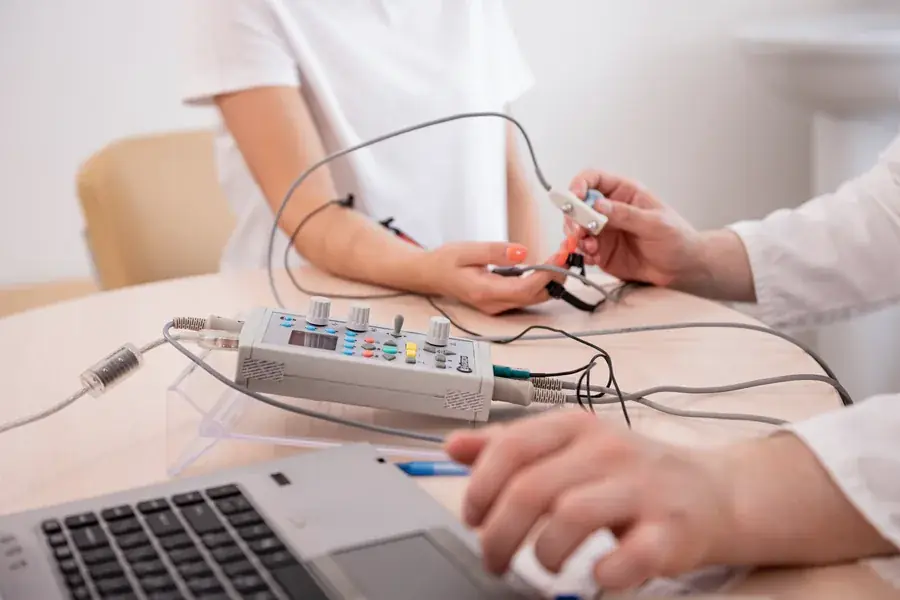
- Nerve conduction study: Electrode stickers are placed on the skin to deliver mild electrical signals and measure how fast those signals travel through your nerves.
- Needle EMG: A small needle electrode is placed into the muscle under your skin. It records muscle activity at rest and during muscle contraction.
Doctors often recommend EMG testing when you have symptoms such as:
- Tingling
- Numbness
- Muscle weakness
- Radiating pain
An EMG helps us determine where the problem is and how severe it is, which helps us develop an individualized treatment plan. Learn more about how we approach nerve pain.
Why imaging alone doesn’t tell the whole story
Imaging such as an X-ray or MRI captures a single moment in time, while EMG tests show how your nerves and muscles function in real time. Imaging can also show age-related changes that look significant but may not be causing your symptoms. EMG testing helps doctors understand how your nerves and muscles are actually working, which helps shape a treatment plan.
At Michigan Center for Regenerative Medicine, we treat imaging and EMG testing as tools that work together. Imaging helps identify the “what,” while EMG helps show the “how.” Combining both lets us take an individualized approach that is otherwise difficult to achieve.
How EMG results help guide your treatment plan
Once our physicians review your imaging and EMG results, we can recommend the best path forward. Structural causes such as inflammation, arthritis or a herniated disc may benefit from orthobiologics such as platelet-rich plasma (PRP) or stem cell therapy, while a steroid injection may be used for shorter-term relief while you address the underlying issue causing your pain.
Whichever path you choose, an EMG combined with thorough imaging gives you the best chance of getting to the root cause of your condition.
Two physicians with extensive EMG testing experience
For EMG testing, a certification in electrodiagnostic medicine shows that a provider has the experience not only to perform the test but also to interpret the results and build an effective treatment plan. Dr. John Santa Ana has extensive physical medicine and rehabilitation (PM&R) training and is also board-certified by the American Board of Electrodiagnostic Medicine (ABEM), which goes beyond standard training into more complex EMG cases.
Dr. Robert Farhat also has extensive EMG testing experience, having performed numerous complex studies over his decades as a board-certified PM&R physician. Having two physicians with this level of EMG experience allows us to offer this diagnostic tool to more of our patients.
Find out what’s behind your nerve symptoms
If you have nerve symptoms but aren’t sure where they’re coming from or who to turn to, our team is here to help. Our physicians, including Dr. John Santa Ana, combine imaging, a thorough examination and nerve testing when needed to find a treatment path for your condition.
Reach out to schedule your first consultation, and we’ll help determine whether EMG testing could provide useful information about your symptoms.
Call our Rochester Hills office at (248) 216-1008 or our Grand Rapids office at (616) 288-1109, or request a consultation online.
Keep learning
Related Articles
Patient Resources
Why Choose Michigan Center for Regenerative Medicine for Treating Chronic Pain?
Why choose MCRM for treating chronic pain? The Michigan Center for Regenerative Medicine has board-certified physicians who start with a thorough evaluation …
Patient Resources
Regenerative Medicine Defined: What Does It Really Mean?
What does regenerative medicine really mean? Regenerative medicine includes treatments designed to support the body’s natural repair and healing processes, rather than …
Patient Resources
Traveling to Get Better Care: Welcoming Out-of-Town Patients
Can out-of-town patients get care at MCRM? Yes. The Michigan Center for Regenerative Medicine sees patients from across Michigan, the country and …

