
Have you been told you may need a knee replacement, or are you seeing your knee pain worsen and wondering how long it will be until surgery is a necessity? While knee replacement may be necessary in some instances, it’s important to understand that there are other options that you can explore that may offer relief without knee replacement surgery. The team of board-certified doctors at The Michigan Center for Regenerative Medicine has built our practice on implementing a variety of regenerative medicine treatment options to help patients avoid surgery or an extended regimen of prescription medications.
The First Step is Always Proper Diagnosis
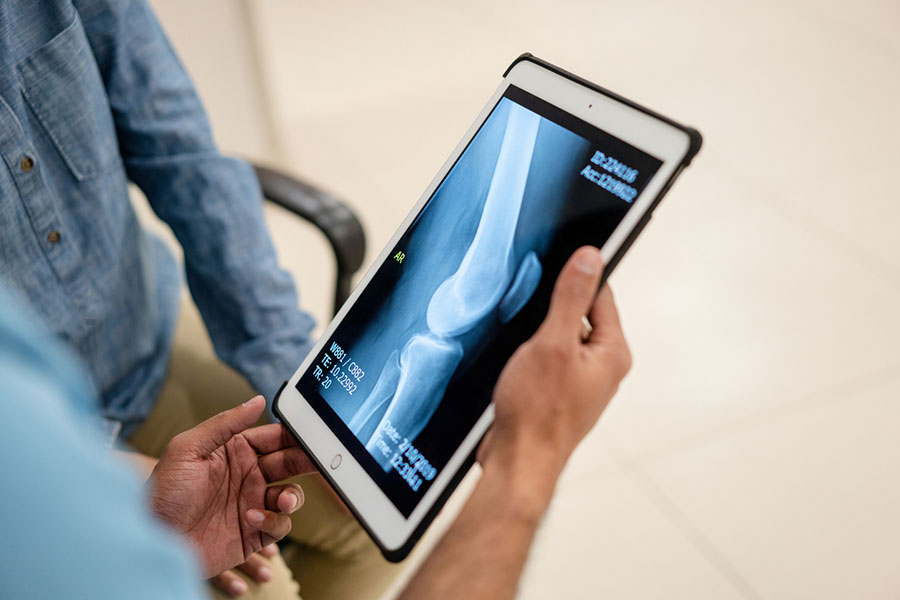
Before any regenerative medicine treatment is discussed, a comprehensive evaluation must take place to understand exactly what is happening with your knee. The team of doctors at The Michigan Center for Regenerative Medicine often refers to this as “The Three P’s of Consultation,” which are Patient Selection, Product Selection, and Procedure Selection. The goal of the initial consultation is to determine both the source and severity of your knee pain. We use imaging, such as X-rays or MRI, to analyze your injury and develop a robust knee pain treatment plan.
The Three P’s – How The Michigan Center for Regenerative Medicine Approaches Every Consultation
Patient Selection
As mentioned above, the first step our doctors need to determine is whether a patient is a good candidate for regenerative medicine. We take a look at a patient’s overall health, the severity of their condition, and their goals. Only after analyzing all of this information do we determine if regenerative medicine is a good fit for the patient.
Product Selection
Based on the severity of the injury, we will often suggest different regenerative treatments. Here are some of the common treatment options we will use for knee injuries:
- Mild to moderate damage – In this instance, we’ll likely recommend PRP or platelet-rich plasma
- Severe osteoarthritis that is heading towards knee replacement – Here, we will likely recommend BMAC or bone marrow aspirate concentrate using intraosseous orthobiologics.
Procedure Selection
The regenerative medicine procedure used varies widely depending on the patient’s condition. Below are a few examples of knee injuries and the regenerative medicine procedure we would use.
Patient A – the acute knee tweak: An otherwise healthy knee was injured in a recent twist. After imaging, our doctors determine that there is a meniscus tear and a medial collateral ligament sprain. In this instance, we would use PRP or platelet-rich plasma on the meniscus and the sprained ligament. This procedure would be minimally invasive and highly specific.
Patient B – progressive osteoarthritis: This patient is much different than patient A. They have had worsening knee pain for years and severe osteoarthritis that has been identified by medical imaging. In this instance, a knee surgeon may recommend total knee replacement. For this type of condition, we would inject intraosseous BMAC (bone marrow aspirate concentrate) orthobiologics throughout the entire knee, including the medial and lateral compartments, ligaments, meniscus, quadriceps tendon, patellar tendon, and joint capsule. We would inject beneath the bone to help stimulate cartilage growth from the inside out.
As you can see, this is just an example of the diverse treatment approaches we offer at The Michigan Center for Regenerative Medicine.
Why Choose Regenerative Medicine Over Surgery?
There are a number of reasons our patients continue to choose regenerative medicine as an alternative to surgery, a few of which include:
- Recovery time – All surgery, even a minor “knee scope,” involves significant downtime. With targeted PRP treatment, you’ll have significantly less downtime, and many of our patients begin rehab activities just a few weeks after their procedure.
- Risk – Surgery carries significant risks due to anesthesia, injections, scarring, and other factors. With regenerative medicine procedures, we’re using a patient’s own cells, which carry far lower risks.
- Let the body heal itself – The whole premise of regenerative medicine is to let the body do what it does best: heal itself. Regenerative treatments help to stimulate the body’s own repair mechanisms and thus preserve the natural joint for as long as possible.
Schedule a Consultation With A Board-Certified Regenerative Medicine Doctor Today
If you’re dealing with knee problems and are worried that knee replacement is your only option, do yourself a favor and schedule a consultation with a member of our medical team today. You can call our office today at (248) 216-1008. Remember, the sooner you begin to address your knee issues, the more options you’ll have for relief and increased mobility.