
PRP Treatment in Rochester MI by Board-certified Physicians
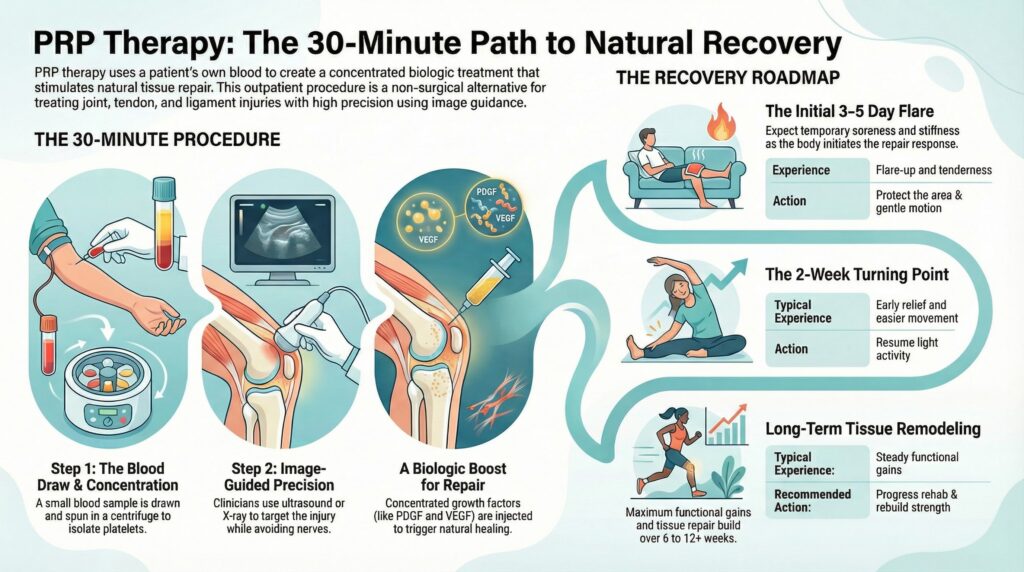
PRP treatment in Rochester, MI uses a small autologous blood draw and centrifugation to concentrate platelets, then targets the area with microinjections, often guided by ultrasound for accuracy.
At Michigan Center For Regenerative Medicine, you’re using platelet-released growth factors to modulate inflammation and support tissue remodeling over weeks, not overnight.
You can expect soreness for 24–72 hours, early change in 2–6 weeks, and clearer improvement by 6–12+ weeks.
Learn more about Platelet Rich Plasma Therapy, then see who qualifies and what conditions it fits.
How to Choose the Right Center for PRP Treatment
- Look for PRP providers using sterile, closed-system centrifugation with clear documentation of platelet preparation method, dose, and injection sites.
- Choose clinicians with PRP-specific training who use ultrasound guidance when appropriate to improve accuracy and reduce variability.
- Confirm candidacy screening includes history, exam, medication review, and labs when indicated, and checks contraindications like infection or bleeding disorders.
- Expect temporary soreness, swelling, and bruising; typical improvement begins 2–6 weeks, with measurable gains often appearing by 6–12+ weeks.
- Ask about your specific goal, hair restoration, skin rejuvenation, or musculoskeletal pain, and the recommended session plan, follow-ups, and maintenance.
To learn more about PRP treatment in Rochester MI, call The Michigan Center for Regenerative Medicine today at (248) 216-1008.
Ask About Alternatives to Surgery for Your Chronic Pain
Contact the Michigan Center for Regenerative Medicine Today and Schedule Your Office Visit
What Is Rochester PRP Treatment, and How Does It Work?
PRP (platelet-rich plasma) treatment uses a concentrated portion of your own blood to deliver a high dose of platelets and growth factors to a targeted area.
You’ll start with a brief blood draw, then clinicians centrifuge it to separate and concentrate platelets within plasma.
You benefit because Platelet Biology supports tissue repair signaling.
When platelets reach the treatment site, they release bioactive proteins that can modulate inflammation, support angiogenesis, and promote extracellular matrix remodeling.
Your clinician guides placement with exam findings and, when appropriate, ultrasound to improve accuracy and reduce variability.
The Activation Process may occur via exposure to collagen at the injury site or through clinician-selected activation methods, prompting platelets to degranulate and deliver growth factors in a controlled, localized manner.
You can apply this option when you want to restore function efficiently, helping you stay capable of caring for others while pursuing evidence-based recovery.
Is PRP Safe in Rochester, and What Are the Risks?
Because the injection uses your own concentrated platelets and growth factors, the next question is how safe it’s and what complications you should realistically consider.
PRP is generally well tolerated when clinicians follow strict blood handling and infection control standards, including sterile collection, closed centrifugation when available, and single-use needles and syringes.
Since the product is autologous, allergic reactions are uncommon, and disease transmission risk is low when protocols are followed.
You should still plan for typical injection-related effects: temporary pain, swelling, warmth, bruising, or stiffness at the site.
Less common risks include bleeding, nerve irritation, or a flare of inflammation for several days.
Infection is rare but serious; you’ll want clear post-procedure instructions and prompt evaluation for increasing redness, drainage, fever, or escalating pain.
If imaging guidance is used, it can improve accuracy and may reduce unintended tissue injury.
Who’s a Good Candidate for PRP in Rochester, MI?
When does PRP make the most sense for you in Rochester, MI? You’re a strong candidate when you’re medically stable, can follow a structured plan, and want a biologic option that uses your own blood products.
You’ll do best if you can commit to follow-up visits and activity guidance, since outcomes depend on adherence as much as technique.
Your clinician will confirm candidacy through history, exam, and medication review, with labs when indicated.
You may not qualify if you have active infection, uncontrolled systemic disease, significant bleeding disorders, severe anemia, or you can’t pause contraindicated anticoagulants when medically appropriate.
Expectations:
- Screening matters: you’ll benefit most when you understand PRP isn’t an instant fix and results can vary.
- Psychological Readiness counts too, you’re more likely to stay consistent, tolerate short-term discomfort, and keep serving others while you recover.
What Can PRP Treat in Rochester, MI?
In Rochester, MI, you can use PRP to support hair restoration for androgenetic alopecia by promoting follicular activity and improving hair density.
You can also apply PRP for skin rejuvenation to enhance texture and tone by stimulating collagen remodeling.
For musculoskeletal care, you can use PRP to help reduce joint pain and improve function in select degenerative or overuse conditions.
Hair Restoration Applications
Restoring thinning hair with platelet-rich plasma (PRP) targets common, non-scarring hair loss patterns by using your own concentrated growth factors to support follicle function.
In Rochester, MI, you can use PRP for androgenetic alopecia and diffuse shedding when follicles remain viable.
Your clinician performs follicle mapping to identify miniaturized zones and set measurable density goals.
PRP is injected into the scalp to modulate inflammation and support anagen signaling, typically in a series with maintenance.
You’ll get the best outcomes when you pair treatment with medical therapy and correct iron or thyroid issues.
If you’re planning a transplant, PRP supports donor optimization and graft environment.
You’re choosing a low-allergen, autologous option that helps you show up confidently for the people you serve.
Rochester Skin Rejuvenation Benefits
Boosting collagen signaling with platelet-rich plasma (PRP) can improve early photoaging and texture concerns by delivering a concentrated mix of autologous growth factors to the dermis.
You’ll typically see smoother tone, reduced fine lines, and improved elasticity as fibroblasts increase matrix production and microvascular support.
When you combine PRP with microneedling, you can enhance transdermal delivery and stimulate controlled remodeling for Scar minimization, including acne and surgical scars.
You can also target Pigmentation correction by supporting epidermal turnover and reducing post-inflammatory discoloration over a series of sessions.
Because PRP uses your own platelets, you minimize immunologic risk and downtime, helping you return quickly to caring for your family, patients, or community with confidence and consistency.
Rochester Joint Pain Relief
When joint pain limits your movement, PRP injections may help reduce symptoms in select musculoskeletal conditions by delivering a high concentration of your own platelets and signaling proteins to irritated or degenerative tissue.
You’ll often use PRP for knee osteoarthritis, mild hip degeneration, or tendinous pain around the shoulder and elbow when imaging and exam match inflammation or early wear.
You’ll pair treatment with Exercise Therapy and Weight Management to improve joint loading and keep you serving others without overexertion.
| Joint focus | Typical goal | Your action |
|---|---|---|
| Knee | Less pain, better stairs | Strengthen quads |
| Hip | Improved gait tolerance | Manage load |
| Shoulder | Smoother reach overhead | Restore mechanics |
You should expect gradual change over weeks, not instant relief, and you’ll track function, not just pain scores.
Can PRP Help Joint Pain in Rochester, MI?
Although joint pain can stem from osteoarthritis, tendon irritation, or minor cartilage damage, PRP (platelet-rich plasma) may reduce pain and improve function by delivering a concentrated dose of your own platelets and growth factors to the affected joint.
In Rochester, MI, you’ll typically undergo a structured evaluation, imaging when indicated, and an ultrasound-guided injection designed to target intra-articular inflammation and support tissue homeostasis.
You can serve your family and community more reliably when your plan stays measurable and safe:
- You’ll confirm candidacy by evaluating pain pattern, range of motion, and functional limits.
- You’ll set outcomes (stairs, walking tolerance, sleep) and track them over 6–12 weeks.
- You’ll pair PRP with Exercise guidance to protect the joint and improve mechanics.
- You’ll review Patient testimonials cautiously, prioritizing peer-reviewed data and your response.
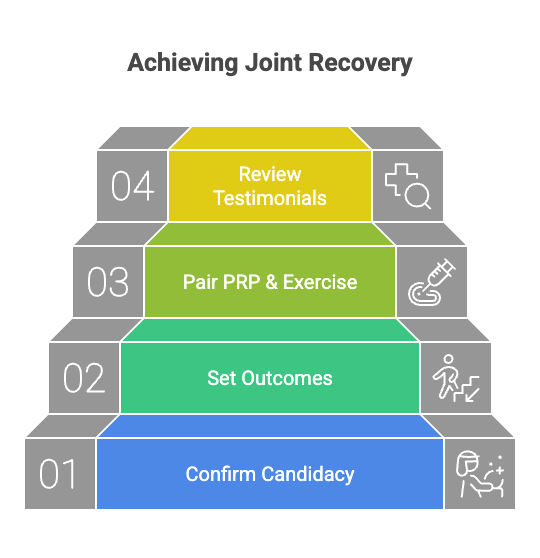
You should expect gradual change, not overnight relief, and you’ll reassess next steps with your clinician.
Can PRP Help Tendon Injuries in Rochester, MI?
Because tendons recover slowly and often stay irritated under repeated load, PRP may help certain tendon injuries in Rochester, MI by delivering a concentrated portion of your own platelets and signaling proteins to the degenerative portion of the tendon. You’ll typically start with an exam that links symptoms to Tendon biomechanics and training demands, then confirm pathology with imaging. With Ultrasound guidance, your clinician can place PRP precisely at the diseased tendon region, not the surrounding sheath, which may improve targeting and safety. Evidence suggests PRP can reduce pain and support function in chronic tendinopathy, especially when you pair it with progressive loading.
| Tendon problem | Goal with PRP | Your role |
|---|---|---|
| Lateral epicondylopathy | Decrease pain, improve grip | Eccentric loading plan |
| Patellar tendinopathy | Support remodeling | Jump volume control |
| Achilles tendinopathy | Improve tolerance | Calf strengthening, pacing |
If you serve others physically, clearer function helps you keep showing up.
Can PRP Help Hair Loss in Rochester, MI?
How might PRP help hair loss in Rochester, MI?
You can use platelet-rich plasma to deliver autologous growth factors to scalp follicles, supporting anagen progression and improving hair density in select patients with androgenetic alopecia.
You’ll need a medical evaluation to rule out telogen effluvium, thyroid disease, iron deficiency, or scarring alopecia before you commit.
PRP works best when you pair it with disciplined care and realistic goals, especially amid climate effects like winter dryness that can worsen scalp irritation and shedding.
Community attitudes here often favor natural, service-minded choices, so you can view PRP as a way to restore confidence while staying available to others.
- Confirm diagnosis with history, exam, and photos.
- Plan a protocol (often 3 sessions, 4–6 weeks apart).
- Track outcomes with standardized measurements, not anecdotes.
- Maintain gains with periodic boosters and evidence-based adjuncts.
Can PRP Improve Skin Texture and Tone?
When you want a subtle, biologic boost to skin quality, PRP can improve texture and tone by delivering concentrated autologous platelets and growth factors that support collagen remodeling, dermal hydration, and more even light reflection.
You’re leveraging signaling proteins that may enhance fibroblast activity, support extracellular matrix turnover, and reduce the look of fine roughness and blotchy discoloration over time.
If you serve others in patient-facing roles, you’ll appreciate changes that look rested, not “done.” You can track progress with Objective Assessment rather than impressions alone, using standardized photos, validated skin-scoring tools, and symptom checklists for dryness or sensitivity.
Imaging Techniques such as cross-polarized photography or 3D surface analysis can quantify pore appearance, texture irregularity, and diffuse redness, helping you match goals to measurable endpoints.
Results vary by baseline photoaging, inflammation, and adherence to sun protection and barrier-supportive skincare routines.
What Happens at a PRP Appointment in Rochester, MI?
Expect a structured, protocol-driven visit that starts with a brief medical review and informed consent, then moves to standardized photos and a focused skin or scalp exam to confirm candidacy and define measurable endpoints.
You’ll arrive early to manage parking logistics, then settle into a calm clinic ambiance designed to support focused care.
Your clinician draws a small blood sample, labels it, and centrifuges it to concentrate platelets under closed-system standards.
Next, they cleanse the treatment area, apply topical anesthetic when appropriate, and map injection sites to match your goals and anatomical landmarks.
- Verify contraindications, meds, and baseline vitals.
- Confirm platelet prep method and sterile field setup.
- Deliver PRP via microinjections or targeted techniques, monitoring comfort.
- Document dose, lot tracking, and post-visit care steps.
You’ll leave with clear instructions so you can return to serving others without unnecessary disruption.
PRP Recovery: When Will You See Results?
After PRP treatment in Rochester, MI, you’ll typically notice soreness for 24–72 hours, early symptom change over 2–6 weeks, and more measurable improvement around 6–12 weeks as tissue remodeling progresses.
You won’t see the same timeline as someone else because platelet concentration, the condition treated and its chronicity, injection site, and your activity level and adherence to post-procedure restrictions all affect response speed.
You’ll get the most accurate expectation when you track symptoms and function at set intervals with your clinician.
Typical PRP Healing Timeline
In the days and weeks following PRP, your tissues move through a predictable sequence, early inflammation, cellular signaling, and gradual remodeling, so improvements typically build rather than appear overnight.
Circadian timing can shape how you perceive soreness and energy, and a Placebo response may influence early symptom reporting, but the biologic timeline remains fairly consistent.
- Days 1–3: Expect localized warmth, stiffness, and tenderness; protect the area while staying gently mobile.
- Days 4–14: Discomfort usually settles; you’ll often notice steadier function rather than dramatic pain relief.
- Weeks 3–6: Collagen organization and neovascular signaling support measurable gains in strength and tolerance.
- Weeks 6–12+: Remodeling continues; you can reintroduce higher-demand tasks to better serve others without flare-ups.
Factors Affecting Result Speed
Several variables determine how quickly you’ll notice meaningful improvement after PRP, even when the injection technique and biologic recovery phases stay consistent. Your tissue baseline, dose loading, and adherence to rehab shape symptom change, often before imaging changes. Optimize what you can so you’re ready to keep serving others without setbacks.
| Factor | What you control | Expected effect on speed |
|---|---|---|
| Sleep quality | 7–9 hours, regular schedule | Faster pain and function gains |
| Smoking status | Quit or reduce nicotine exposure | Slower recovery if ongoing |
| Load management | Follow graded activity plan | Prevents flare-ups, steadier progress |
You’ll typically progress faster when you treat PRP like a protocol: hydrate, avoid NSAIDs as directed, keep protein adequate, and attend follow-ups. If you’ve had chronic degeneration or systemic inflammation, expect a longer runway, and measure progress weekly, not daily.
How Much Does PRP Cost in Rochester, MI, and How Do You Choose a Provider?
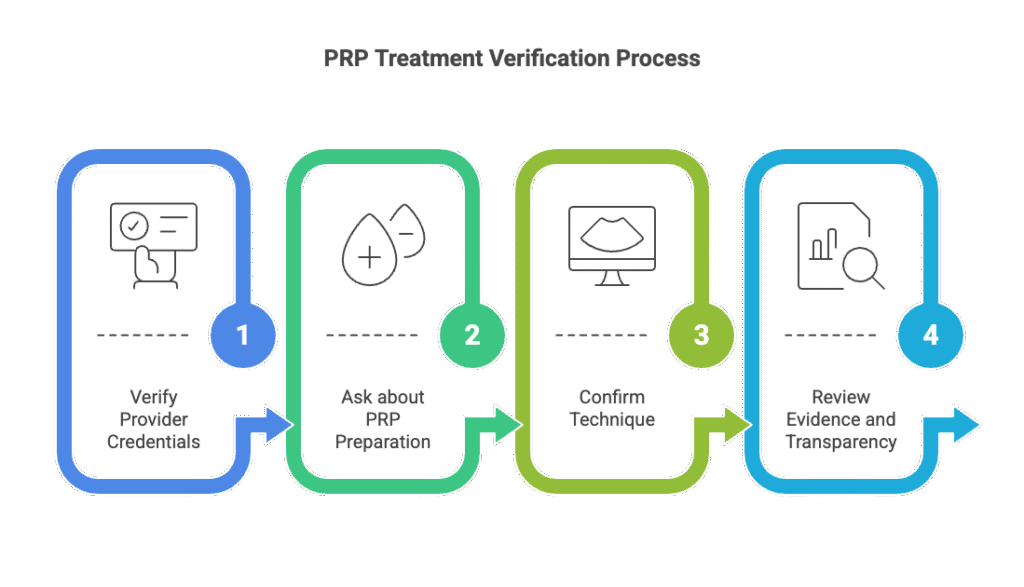
To choose a provider, prioritize safety, reproducibility, and outcomes you can measure:
Prioritize safety, reproducibility, and measurable outcomes when choosing a provider, not promises or hype.
- Verify Provider Credentials (board certification, PRP-specific training, complication protocols).
- Ask how PRP is prepared (platelet concentration targets, leukocyte content, sterility controls).
- Confirm technique (ultrasound guidance, documentation of site, volume, and intervals).
- Review evidence and transparency (published data, realistic timelines, and rehab coordination).
You’re not buying a shot;
you’re selecting a clinical system that supports predictable recovery and responsible stewardship of your time and resources.
PRP uses your own platelets to deliver growth factors that may support tissue repair and collagen remodeling. In Rochester, MI, you’re typically a good candidate if you have mild to moderate tendon, ligament, or joint symptoms, or you want non-surgical skin rejuvenation.
Learn more about Platelet Rich Plasma Therapy at Michigan Center For Regenerative Medicine.
PRP is generally well tolerated; risks include pain, bruising, swelling, infection, or no benefit. Expect gradual improvement over weeks to months.
Choose a provider who uses sterile technique, clear protocols, and outcome tracking.


A Better Solution for Chronic Pain Management
Today, PRP treatment in Rochester Hills MI is used in mainstream patients for quick preparation and delivery of treatment. Full healing from start to finish takes place in six to eight weeks. However, you should be feeling much better by the second week. Most people just need one treatment but some people, such as those with a severe condition or disease, may require multiple rounds of PRP treatments in Rochester Hills MI.
PRP, a trusted treatment in sports medicine for decades, has been helpful in getting athletes to heal more readily after injury. Speedier wound healing and bone-grafting processes in the fields of neurosurgery, maxillofacial surgery, otolaryngology and orthopedic surgery are additional benefits to PRP treatment in Rochester Hills MI.
Upon offering your blood sample, it takes just 30 minutes to prepare your treatment. Featuring minimal risks and exceptional effectiveness rates, PRP follows a simple process:
- Platelets become separated aside from other blood cells and concentrated with centrifugation.
- The concentrated platelets are then again combined with the rest of the blood and injected directly into the affected area.
- All injections are guided with ultrasound or x-ray to pinpoint exactly where the area of injury is.


Take Advantage of New Advancements in Regenerative Medicine Provided by Board-certified Doctors
Contact Michigan Center for Regenerative Medicine Today and Discover If You are a Candidate. Home Office and Medical Center located at 355 Barclay Cir Suite A Rochester Hills, MI 48307
- PRP Treatment Troy MI
- PRP Treatment Rochester Hills MI
- PRP Treatment Northville MI
- PRP Treatment Metro Detroit
- PRP Treatment Detroit
- PRP Treatment Novi MI
- PRP Treatment Bloomfield Hills MI
- PRP Treatment Birmingham MI
- PRP Treatment West Bloomfield MI
- PRP Treatment Near You
- PRP Treatment Near Pontiac MI
- PRP Treatment Near Lansing MI
- PRP Treatment Near Grand Rapids MI
- PRP Treatment near Flint MI
- PRP Treatment Near Farmington MI
- PRP Treatment near Downtown Detroit
- PRP Treatment near Milford MI