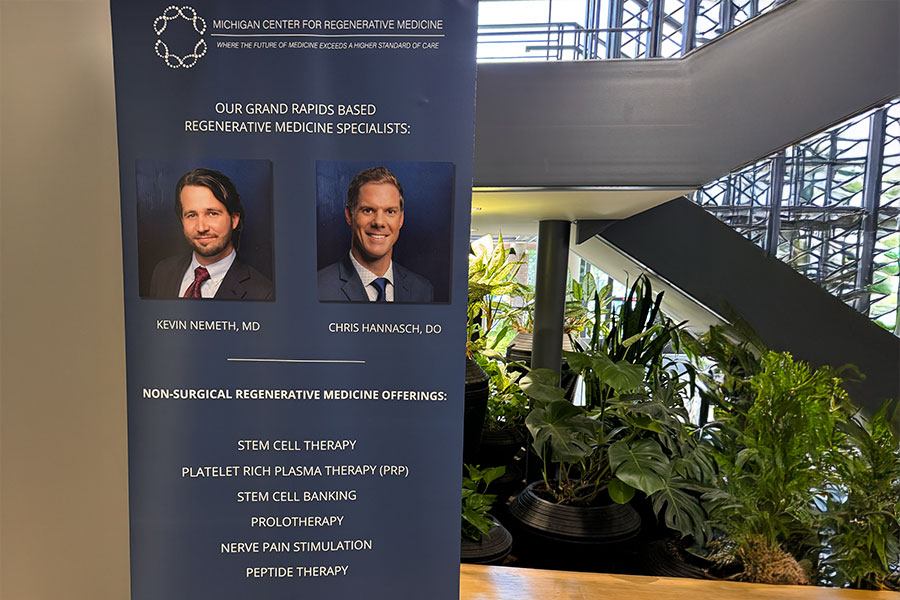
While it’s been a long time coming, we’re extremely excited to announce that our new Grand Rapids office is officially open. Our new office is located at 1000 East Paris Avenue, SE, Suite 221, in Grand Rapids. If you need to reach us, you can call our new office at (616) 288-1109. We thought it would be a good idea to have a Q&A session with our very own Dr. Kevin Nemeth, who is one of the main providers at the new Grand Rapids clinic. We hope this will help you get to know Dr. Nemeth and our practice better.
You’re board-certified in Anesthesiology and Pain Medicine. What does this give you insight into that a single certification would not?
My primary specialty, anesthesiology, is one of the few specialties, at least back when I was training, that routinely used ultrasound, especially when we were doing perioperative blocks. I had early exposure over the course of a four-year residency to hands-on musculoskeletal ultrasound use, which is one of the tenets of best-evidence regenerative medicine care.
Additionally, while I was training, most of the pain trainees had an anesthesiology background. So, I had a lot of pain medicine incorporated into my residency program as well. Pain management is a natural segue into regenerative medicine given the types of procedures we perform. Often, the type of procedures we’re doing in regenerative medicine are the exact same procedures that we’d be doing under traditional pain management, which is insurance-based care. The main difference is just the substrate that we’re injecting. With traditional pain management, we’re often using steroid-based injections, while in orthobiologics, we’re using a patient’s own cells.
What professional societies are you a member of?
I’m an active member of the Interventional Orthobiologics Foundation (IOF), which sets the standard for evidence-based care in regenerative medicine. The Michigan Center for Regenerative Medicine also has leadership roles in the IOF, with Dr. Tom Nabity and Dr. John Santa Ana being instructors and having administrative roles within the society. I’m also a member of the American Society of Anesthesiologists (ASA) and the Michigan Society of Anesthesiologists. Additionally, I’m also a member of the American Society of Interventional Pain Physicians.
What excites you most about the new clinic in Grand Rapids?
I think it’s very evident that there’s a strong demand that’s only growing stronger for orthobiologics procedures and a more complementary form of medicine. I don’t think there are many clinics that do things quite to the standard that we do at The Michigan Center for Regenerative Medicine. There are a number of clinics that offer regenerative therapies, but few are doing it to this level which is why we’re so excited about the formation of the Ortho Healthspan Alliance that we helped found. The goal of the Ortho Healthspan Alliance is to be the gold standard for regenerative medicine that everyone can aspire to nationally.
What makes The Michigan Center for Regenerative Medicine different from other clinics in the area or across the country?
When I have consultations with patients, I routinely tell them there are three pillars which I often refer to as the “three D’s” that provide the best chance for a successful outcome from orthobiologics.
The first pillar is diagnosis. Having an appropriate diagnosis is of paramount importance to receiving the right treatment and ultimately producing a good outcome. You need to have a knowledgeable, skilled physician with a background in pain management, but who is also involved in the physiatry, musculoskeletal, or orthopedic world to arrive at an accurate diagnosis.
The second pillar is dose, and this is a big separator for many regenerative medicine clinics. You need to know the dose of what you’re treating, and you can’t know that unless you’re analyzing the blood sample harvested from a patient. Most blood draw kits that suppliers use draw only 60 cc’s of blood. In our opinion, 60 cc of blood is not enough to treat many of the conditions our patients come to us for. The literature indicates that you need at least 10 billion platelets to effectively treat many of these conditions. The problem is, unless you have an abnormally high platelet count at baseline, it’s very difficult to get 10 billion platelets out of a 60 cc blood draw. This is why our standard blood draw is 200 milliliters, which may sound like a lot, but it’s still less than your typical blood donation. This allows us obviously a higher dose of platelets, and when we analyze the sample, we are routinely able to get more than 10 billion platelets, which is an ample dosage for a regenerative medicine treatment.
Finally the third pillar is delivery. At our clinic, we use image-guided precision in our treatments because it doesn’t matter how well you think you are injecting into a specific joint or soft tissue; if you’re not visualizing the area, there’s a chance you’re not injecting the right spot. Several studies have shown that using image guidance during an orthobiologic injection greatly improves outcomes.
At The Michigan Center for Regenerative Medicine, these three pillars of care (diagnosis, dose, and delivery) are paramount to everything we do to ensure we provide the highest level of care for our patients.
How quickly can someone get in to see you at the Grand Rapids office? What is to be expected at someone’s first visit?
We are typically able to schedule new patients within 1-2 weeks. Our first visit is an in-depth consultation. We typically dedicate between 45 minutes and 1 hour where we do an in-depth history and physical exam, go over any imaging, and, if necessary, perform a bedside ultrasound exam.
During this exam, we start with the patient’s expectations and goals. Because at the end of the day, this is one of the benefits of our type of care. Because many of the regenerative procedures aren’t under insurance care, you are able to treat multiple issues more intuitively. However, it’s important to know that if there is anything that’s covered by insurance, we run it through insurance, and if something is not covered by insurance, then that’s the only time that there will be an out-of-pocket expense. Most of the initial consultations are covered by insurance, and then we can determine the best course of treatment and what part of that treatment is or is not covered by insurance.
Interested in Scheduling a Consultation with Dr. Nemeth At Our Grand Rapids Office to Learn More About Regenerative Medicine?
We hope this regenerative medicine Q&A with Dr. Nemeth was informative. If you’re interested in learning more about the constantly evolving world of regenerative medicine, or you’re ready to schedule a consultation with Dr. Nemeth, feel free to call our Grand Rapids office today at (616) 288-1109.